Local land records also say the land at Kalapani and Lipulekh belongs to the residents of two villages on the Indian side of the border, an official recently said.

On his recent visit to China, the President made eminently sensible suggestions to improve relations except that they can't work in the present atmosphere.
'The meeting marks the first tentative step in the effort to understand whether the two largest Asian nations can co-exist peacefully while realising their aspirations.' 'Caution and watchful wariness will dominate the effort of both sides,' says Jayadeva Ranade, former RA&W officer and China expert.

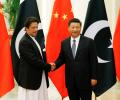
Prime Minister Modi told President Xi that he has made efforts to improve ties with Islamabad but these efforts have been "derailed".
In all the noise surrounding the Dok La confrontation, Claude Arpi focuses on a crucial issue that has hardly been covered -- the construction of roads for the armed forces and the local population to reach the most remote border posts.
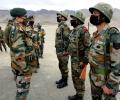
The Indian delegation led by Lt General Harinder Singh, the general officer commanding of Leh-based 14 Corps, and Commander of the Tibet Military District Maj Gen Liu Lin held an extensive meeting in Maldo on the Chinese side of the Line of Actual Control in eastern Ladakh on Saturday that began at around 11.30 am and went on till evening.

China's military on Thursday expressed concern over India's plan to construct 54 new border posts in Arunachal Pradesh, saying India should not complicate the situation.

Singh emphasised that the Indo-Pacific is no more a maritime construct, but a full-fledged geo-strategic issue, and that the region is facing "a complex web" of security challenges, including boundary disputes and piracy.
External Affairs Minister S Jaishankar said on Wednesday China has given India 'five differing explanations' for deploying large forces at the Line of Actual Control (LAC), adding this violation of bilateral pacts has 'very significantly damaged' their relationship that is now at its 'most difficult phase' in the last 30-40 years.
'The Indian Army's surveillance had noticed the Chinese movements.' 'There was no intelligence failure.'
China has vehemently rejected all reports of it ever offering a compromise to India by relocating its troops in the disputed Doklam area.

In an address at the Indian Council of World Affairs, he said Nepal wants to take the relations with India to the next level, but at the same time added: "We should be mindful equally that healthy relations require continuous nurturing, creative thinking, promptness and readiness to understand each other in changing dynamics."
Ten days later, with the Indian Army in full control of the area where the incident took place, New Delhi has signalled a face-saver for Beijing.

Asserting that there are no problems which cannot be resolved, India on Tuesday said it would like to address all its issues with Pakistan through talks while having an "effective deterrence" to deal with terrorism emanating from there.

Union Home Minister Rajnath Singh on Tuesday said India and Bangladesh would soon approve the Teesta water sharing agreement.
Suddenly the sands are shifting and even friends are acting strange.
Singh said a meeting between senior Indian and Chinese military leaders has been scheduled for June 6 even as he asserted that India is not going to back off from its position. Asked about the current situation in sensitive areas in eastern Ladakh, he said Chinese have come up to what they claim is their territory while Indians believed it is theirs.
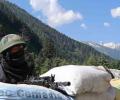
The Army Chief was in Ladakh on a two-day visit from June 23 to take stock of the situation.
Gilgit Baltistan's large frontage with Kashmir and Ladakh across Kargil and the Siachen Glacier gives Pakistan and China the perceived scope for conduct of collusive operations against India and wrest control of the major course of the Indus and Shyok, observes Lieutenant General Syed Ata Hasnain (retd).

Out of 18, four personnel were critically injured but they are responding to treatment and are stable now, people familiar with the matter said.
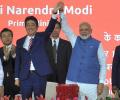
Chinese foreign ministry spokesperson Hua Chunying, while reacting to Japan's plans to step up investments in the northeastern states, told the media that China is opposed to any foreign investment in the areas where it has disputes with India.
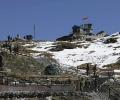
She provided no evidence for the claim, which is at the complete variance with Bhutan's stated position.

'Both Modi and Xi know that if all that there is to show for Modi's visit -- barely eight months after Xi's India trip -- is a repeat of the same old declarations, there will be a terrible sense of letdown in the public mood resulting in future summits losing credibility. Only the possibility of new ground being broken can justify Modi's trip at this time,' says B S Raghavan.

Poland, which currently holds the council's rotating presidency, has listed the matter for discussion at 10 am on Friday, the diplomats were quoted as saying.

By changing the nation's name from India to Bharat, would this landmass overnight lose the emotional and cultural linkage that had been built over generations, centuries and millennia, asks N Sathiya Moorthy.

India said that "a range of issues" were discussed by the two leaders.

'There were two options before the government -- create a complex, cumbersome law, which will cause a tremendous amount of compliance challenges for startups or say let's go back and do a clean slate, where we do a framework of laws and policies'

The ministry of external affairs said the artificial enlargement of territorial claims by Nepal is not based on historical facts or evidence.

Though the Chinese find it necessary to oppose the visits of Indian leaders to Arunachal Pradesh, they want to keep the objections at a moderate level lest it cast a shadow on Narendra Modi's visit to China in May, says D S Rajan.

At least a couple of Chinese military helicopters were spotted flying close to the un-demarcated Sino-India border in the area after the fierce face-off on May 5 following which a fleet of Sukhoi-30 jets of the Indian Air Force too carried out sorties there, the sources said.

'Why wouldn't so strategically-minded an adversary, such as China, not militarily exploit to the maximum Indian timidity, stupidity, and cupidity all along the LAC and legitimate, as it has done so often in the past, the fait accompli of incremental territorial grabs which, by the way, is its strategy and policy as implemented on the ground?'

'We have not had one discussion on the border incursions or the subsequent report of the building of Chinese villages on Indian territory in Arunachal Pradesh.'
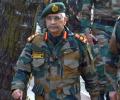
The commanders will also deliberate on the overall situation in Jammu and Kashmir besides delving into issues having national security implications, they said. However, the main focus will be on the situation in eastern Ladakh where Indian and Chinese troops are locked in an eyeball-to-eyeball face-off in Pangong Tso, Galwan Valley, Demchok and Daulat Beg Oldie, the sources said.
'India is not the India of 1962. We are not carrying that baggage of history anymore.'
The PLA said the move has 'seriously damaged' border peace and tranquillity.
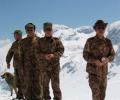
The Indian Army will continue to maintain its aggressive posturing in all disputed areas in eastern Ladakh and will not back off till status quo is maintained, sources said.

'Both have a very nationalistic view of foreign policy.' 'They think they are shrewd and clever diplomats.'
India has maintained there is no scope for a third party mediation.

With tensions between China and Taiwan rapidly increasing, the tone of China's official media has also become progressively more strident, observes former senior RA&W officer and China expert Jayadeva Ranade.
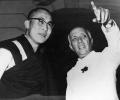
One priority for Delhi (for the new foreign secretary in particular) is to have an in-depth discussion with Dharamsala as soon as possible, suggests Claude Arpi.
